
From M.Com in Finance to Digital Marketing: My Unexpected Career Journey
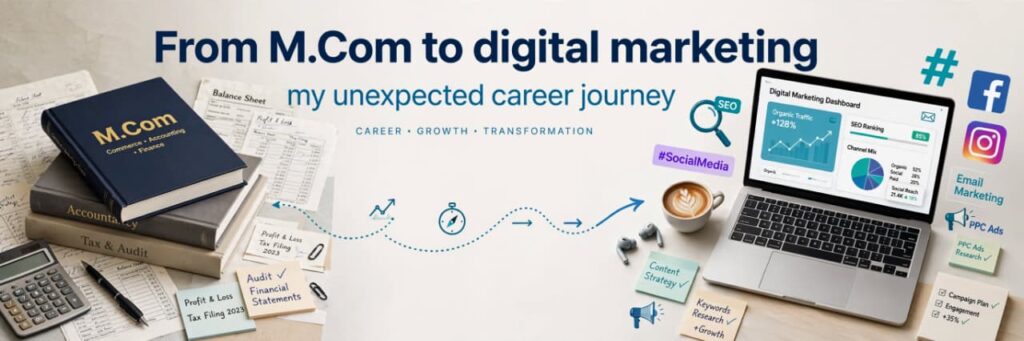
Sometimes, the career we plan is not the career we discover.
I’m Shelna, an M.Com postgraduate specializing in Finance who transitioned into digital marketing through curiosity, practical learning, and continuous skill development. My journey was not based on a fixed career plan. Instead, it evolved as I explored how businesses use digital platforms to connect with audiences and create measurable value.
If you are from a non-marketing background and wondering whether digital marketing could be right for you, my experience may offer a useful perspective: your existing education does not have to limit your future career. In many cases, it can become a valuable foundation.
My Beginning in Finance
After completing my postgraduate studies in M.Com , I developed a strong academic foundation in accounting, finance, business, and management.
My education helped me build practical professional skills, including:
.Analytical thinking
.Attention to detail
. Understanding business decisions
.Working with numbers and data
. Planning and problem-solving
At that stage, I expected my career to continue mainly in finance-related roles. However, as I explored new professional opportunities, I became increasingly curious about the way businesses were building their presence online.
That curiosity became the starting point of an unexpected career transition
Discovering Digital Marketing
My introduction to digital marketing happened gradually rather than through a carefully planned roadmap.
I began observing how brands use websites, social media, search engines, content, online advertising, and storytelling to reach potential customers. I wanted to understand what made some digital campaigns effective and how businesses measured their online performance.
As I learned more, I realized that digital marketing is not simply about posting on social media. It involves a combination of:
– Business strategy
– Audience research
– Content creation
– Search visibility
– Communication
– Technology
– Data analysis
– Performance measurement
This combination of creativity and structured thinking attracted me. It also showed me that my finance background could be relevant in a field that initially seemed completely different.
From Numbers to Creativity
At first, I questioned whether someone with a finance background could successfully move into digital marketing.
Over time, I understood that I did not need to leave my previous education behind. Instead, I could apply the skills I had already developed in a new context.
Finance taught me to study information, identify patterns, evaluate results, and make decisions based on evidence. Digital marketing allowed me to use those abilities while also developing skills in communication, creativity, branding, and audience engagement.
Although finance and digital marketing may appear unrelated, both fields require:
– Clear objectives
– Careful planning
– Consistent execution
– Attention to detail
– Performance analysis
– Data-informed decision-making
This connection gave me the confidence to continue building my knowledge in digital marketing.
Learning Digital Marketing Through Practical Training
To develop a stronger understanding of the field, I pursued practical digital marketing training. This helped me move beyond general awareness and learn how different digital channels support business goals.
My learning journey introduced me to:
– Search Engine Optimization (SEO)
– Social Media Marketing
– Google Ads
– Content Marketing
– Email Marketing
– Website Management
– Digital Analytics
– Branding and online communication
Practical learning helped me understand that digital marketing requires more than knowing individual tools. A successful strategy depends on understanding the target audience, selecting the right channels, creating relevant content, tracking performance, and improving campaigns based on results.
For example, SEO involves more than adding keywords to a webpage. It requires understanding search intent, creating useful content, improving website experience, and monitoring how users interact with a site. Similarly, paid advertising requires clear objectives, audience targeting, budget management, testing, and performance analysis.
This practical perspective made digital marketing more meaningful and helped me connect learning with real business outcomes.
What My Finance Background Taught Me About Marketing
My M.Com continues to influence the way I approach digital marketing.
It taught me to be analytical, organized, and careful with details. These qualities are useful when reviewing website performance, analysing campaign results, researching keywords, studying audience behaviour, or evaluating marketing objectives.
Creativity is important in digital marketing, but creativity becomes more effective when it is supported by strategy and data.
For instance, a creative campaign may attract attention, but performance data helps determine whether it is reaching the right audience and contributing to a meaningful goal. Metrics such as traffic, engagement, conversions, cost per result, and return on investment can help marketers make better decisions.
This is why I no longer see finance and digital marketing as two separate paths. I see them as complementary parts of my professional identity:
– Finance strengthened my analytical foundation.
– Digital marketing developed my communication and creative skills.
– Together, they help me approach marketing with both imagination and measurable objectives.
Why I Chose to Continue in Digital Marketing
I did not enter digital marketing with a perfectly planned career roadmap. I entered it with curiosity.
That curiosity led to learning. Learning led to practice. Practice helped me identify a career direction that I genuinely wanted to explore.
What encouraged me to continue was the dynamic nature of the field. Digital marketing changes constantly as consumer behaviour, search technology, social platforms, advertising systems, and artificial intelligence continue to evolve.
This means digital marketers must remain adaptable and committed to continuous learning. There is always an opportunity to improve a strategy, understand an audience more deeply, test a new approach, or learn a new tool.
For me, this ongoing development is one of the most rewarding aspects of the profession.
Lessons From My Career Transition
My transition from finance to digital marketing has taught me several important lessons:
1. Your academic background does not define your entire career
A degree can provide valuable knowledge and transferable skills, but it does not have to determine every role you pursue. Skills such as analysis, communication, research, and problem-solving can be applied across different industries.
2. Curiosity can become a career direction
You do not always need to have every step planned before beginning. Sometimes, exploring a subject with genuine interest can reveal opportunities you had not considered before.
3. Transferable skills matter
My finance background helped me develop analytical thinking and attention to detail. These skills continue to support my work and learning in digital marketing.
4. Practical learning builds confidence
Reading about digital marketing is useful, but applying concepts through projects, campaigns, website analysis, content planning, or performance reviews creates deeper understanding.
5. Continuous learning is essential
Digital marketing is not a field where learning ends after completing one course. Search engines, platforms, tools, technologies, and user behaviour continue to change, making ongoing development necessary
My Journey Is Still Growing
Today, I am continuing to build my skills in digital marketing while developing my professional identity.
My goal is not simply to learn tools or follow trends. I want to understand why a strategy works, how brands communicate with their audiences, and how digital platforms can create meaningful business value.
I am still learning, experimenting, creating, and improving. I am also working to strengthen my understanding of SEO, social media marketing, content marketing, Google Ads, website management, analytics, and digital strategy.
My journey is still developing, but it is now guided by a clearer purpose: to combine analytical thinking with creativity and help create digital experiences that are useful, relevant, and measurable.
Final Thoughts
From finance to digital marketing, my career path was not the one I originally planned. However, it became a direction I consciously chose to explore.
This experience has shown me that career transitions do not always require starting from zero. Your previous education, skills, and experiences can become valuable assets when applied in a new field.
If you are considering a move into digital marketing from another background, begin with curiosity, learn the fundamentals, practise consistently, and focus on understanding how your skills can create value.
An unexpected beginning can become an intentional future.
About the Author
Shelna T P is an M.Com postgraduate in Finance from the University of Calicut who transitioned into the field of digital marketing. As a digital marketing aspirant at CDA Academy, she is continuously developing her skills across SEO, social media marketing, content marketing, Google Ads, website management, analytics, and digital strategy
With a background in finance and a growing passion for digital marketing, Shelna combines analytical thinking, creativity, and strategic learning to understand how digital marketing can support both audiences and business goals
She believes in continuous learning, meaningful creativity, and strategy-driven digital growth, and is focused on building practical expertise while growing her professional journey in digital marketing.